The First Quiet Five: giving your morning back to yourself

Most days begin with a theft.
Not of time—you still get your twenty-four hours—but of direction. Before your feet touch the floor, other people’s words flood your eyes. Headlines. Messages. A calendar ping you didn’t remember accepting. Your nervous system sprints before you’ve even stood up.
There’s a kinder way to start: five quiet minutes that belong to you and no one else. Not a routine to show off. Not a monk’s vow. Just a brief, honest window where you let your body arrive, choose your first thought, and set the tone you’d like the rest of the day to imitate.
It won’t make your life perfect. It will make the next hour saner. That’s enough.
What the First Quiet Five actually is
It’s simple:
- No input for the first five minutes after you wake.
- One small sequence that helps a human body switch on without panic.
- One sentence that tells your attention where to stand.
That’s it. No tracking, no scoring. Five minutes of ownership.
Why it works (in plain human language)
Mornings are delicate. Your brain is changing gears; your body is clearing fog. If you throw a bucket of noise at it—alerts, drama, a to-do list—your mind scrambles instead of arriving. Give it a short, predictable landing strip and it responds in kind: calmer heart, steadier focus, less flinch when the day asks for something hard.
This is discipline at its gentlest: not force, but framing.
The sequence (copy it as-is, then make it yours)
1) Light
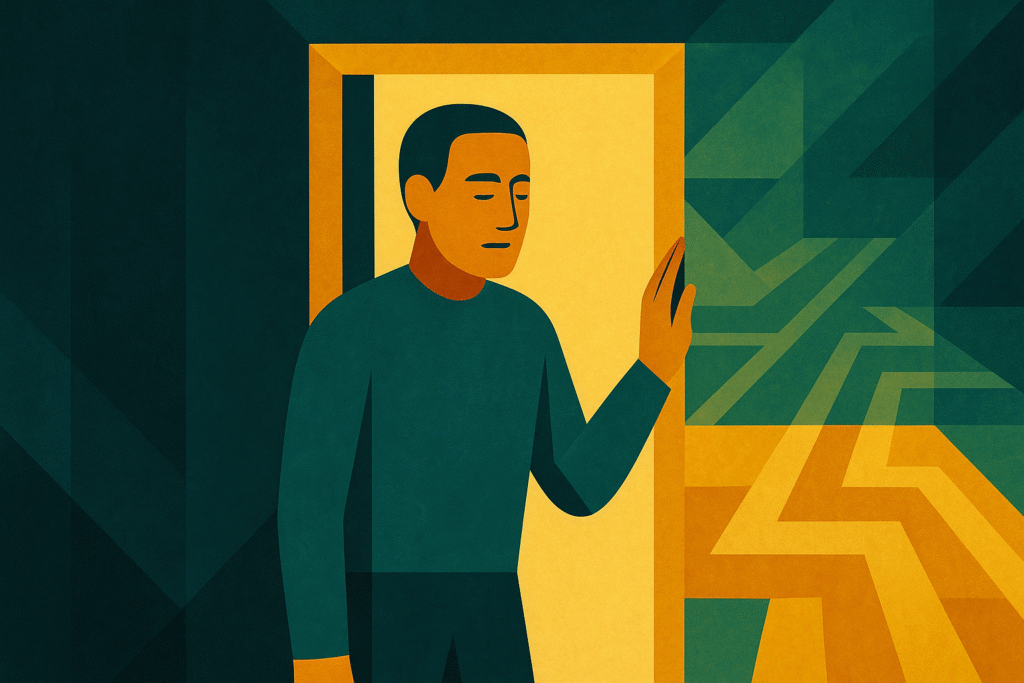
Open the curtain or step to the doorway. Let natural light touch your eyes (no staring at the sun). If it’s dark out, turn on a lamp that isn’t your phone. The message is simple: we’re awake now.
2) Water
Half a glass. Not heroic. Your body has been dry for hours; this flips a few switches. Keep the glass ready the night before. (Future-you is bad at searching.)
3) Posture
Stand tall for two breaths. Shoulders down, jaw soft. This changes how your voice and choices feel. Your first conversation of the day is with gravity—answer kindly.
4) Breath
Four slow rounds: in for four, hold for four, out for four, pause for four. If you get bored, good. Bored is quiet.
5) One sentence
Say it out loud, softly:
“This morning I give one honest window to __.”
Fill the blank with the smallest real thing: open the file, stretch my back, make a clean breakfast, write a paragraph. That’s your north.
Five moves, one minute each. Done.
“But my mornings are chaos.” Perfect—start smaller.
- Sixty-second version: light → sip → two breaths → sentence.
- Parent version: hold the sequence until kids are dressed; then step outside for one minute of light and breath before the car.
- Shift-worker version: do it when your “morning” happens, even if it’s 4 p.m. The clock doesn’t care; your nervous system does.
If the day ambushes you, protect one piece—light or breath. You’re not failing; you’re anchoring.
Making it stick (without turning it into homework)
- Move the phone away from the bed. If it wakes you, let it do that from a shelf across the room. The distance is not moral; it’s mechanical. Your thumb can’t outrun your feet.
- Place the first objects tonight. Glass on the dresser. Curtain cracked. Sticky note with your sentence on the mirror. You’re removing hunt and negotiation.
- Use an “arrival place.” A small spot—a chair by the window, the doorstep, a patch of floor—that your body associates with these five minutes. Familiarity is glue.
- Don’t announce it. This is for you, not for Instagram. The more private it feels, the less your brain turns it into a performance.
- Let it be ordinary. If you miss a day, you didn’t “break” anything. Pick it up tomorrow. Discipline grows in the soil of normal days.
A morning that changed nothing—and changed the day
A reader told me she used to wake into a sprint. Phone in hand. News, mail, a group chat where someone was always upset. She started the First Quiet Five on a Tuesday because Mondays felt too dramatic to change. Curtain. Water. Two breaths. One sentence: “Today I’ll give twenty clean minutes to the proposal.”
She didn’t become a different person. But when the noise arrived (and it did), her body had already found the floor. She opened the file before opening the inbox—not through heroism, through momentum. The proposal wasn’t brilliant. It was begun. That’s what changed.
Common snags (and gentler fixes)
“I grab my phone without thinking.”
Change the environment, not your character. Put the charger outside the bedroom; buy a $10 alarm clock. If you must keep it near, place a book on top so your hand hits pages first.
“I wake anxious.”
Keep the sequence even smaller: stand, breathe once with your hand on your chest, open the curtain. That’s the win.
“Five minutes turn into twenty and I’m late.”
Set a soft timer. The point is not to build a new morning religion; it’s to give your day a clean launch.
“It feels silly to say a sentence.”
Try whispering it. Or write it on a card. Brains love clear instructions more than vague motivation. (Your future self is surprisingly coachable.)
Pair it with one honest window
The Quiet Five sets the tone. Pair it with a Single-Task Window later—a 15–20 minute container for one real thing (write, read, reconcile, stretch). The five minutes say who’s steering; the window is where you drive.
Start tonight (sixty seconds)
Before bed:
- Put a glass where you’ll see it first.
- Crack the curtain or choose a lamp.
- Leave a note with your sentence: “This morning I give one honest window to __.”
Then sleep. Tomorrow, take your five minutes. No noise, no rush, no audience.
When you step into the day, notice the difference: not fireworks, not a new identity. Just a steadier hand on the tiller.
That’s daily discipline at its softest edge—small, repeatable, deeply human.