The Doorframe Pause: choose your next true move at every threshold
Most days don’t fall apart in the middle of a task.
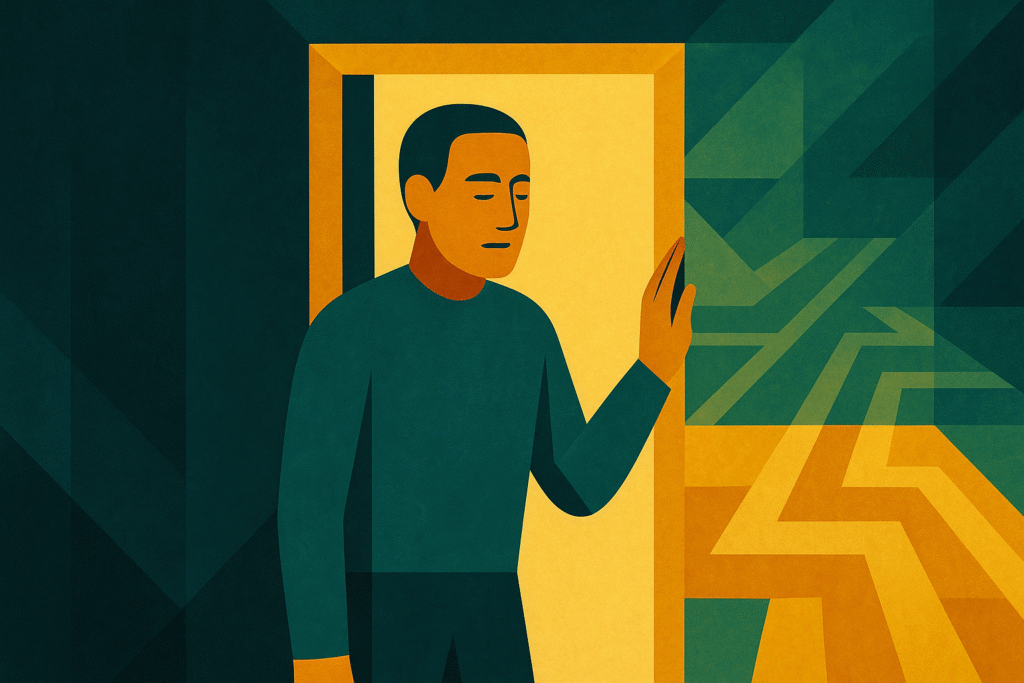
They bend at the thresholds—in the doorway moments between things.
You stand up from the desk to “grab a snack” and return an hour later with crumbs and ten open tabs. You reach the apartment door planning a walk and somehow end up scrolling on the couch. You finish a call and drift into messages because there isn’t a clear next step waiting to be chosen.
Discipline isn’t just about pushing harder inside the work. It’s about what you do at the moment before—the tiny slice where you decide where your attention will live next. That slice is the doorframe.
This piece is about learning a soft skill with a hard effect: a Doorframe Pause—five quiet seconds whenever you cross from one thing to another, to choose your next true move on purpose.
It sounds small because it is. It changes days because it’s everywhere.
Why thresholds decide the shape of your day
Your brain loves closure. Finishing something feels complete; switching is where things fray. At thresholds, habits want to run on autopilot: inbox after meeting, fridge after email, phone after keys. If you don’t have a story for those moments, the environment tells one for you.
The Doorframe Pause gives you a counter-story. At the edge between two scenes, you take ownership for five seconds:
- notice your state,
- name what matters now,
- take the first tiny step.
No lectures. No theatrics. A better hinge.
The simple script (and how to make it feel human)
Every time you pass a threshold—literal (door, elevator, gate) or digital (close tab, hang up, lock screen)—give yourself five seconds:
1) Stop the drift
Feel your feet. Exhale once through your nose. (It’s amazing how quickly your body obeys a breath that belongs to you.)
2) Ask two questions
- What is the one next true move?
- Where do my hands go first?
3) Do the smallest physical action
Open the file. Put on shoes. Start the 15-minute timer. Put the pan on the stove. That’s it. The rest can follow.
This is not about being “mindful” 24/7. It’s about putting a guardrail at the exact place where distraction usually wins.
A day with doorframes (what it looks like in real life)
Morning
You set your mug down. Instead of drifting to messages, you pause at the kitchen doorway, exhale, and ask the two questions. Next true move? Open yesterday’s doc. Hands? Touch keys. You’re typing before your phone remembers you exist.
After a meeting
The call ends. The reflex is to browse. Doorframe Pause: exhale; next true move? Capture two decisions from the meeting. Hands? Write them in the project doc. Five minutes later your head is clearer and the day has a shape.
Coming home
Shoes off. Couch calling. Doorframe Pause at the door: exhale; next true move? Ten-minute walk to wash the noise off. Hands? Keys in the bowl, shoes back on. If it turns into twenty, lovely. If it doesn’t, the link still held.
Evening
Kitchen done. Doorframe Pause before the bedroom: exhale; next true move? Leave tomorrow a breadcrumb. Hands? Open the file, type “Start here → outline intro.” Place headphones on keyboard. You’ve already made the morning easier.
None of this is dramatic. It’s a quiet ownership of the edges.
Five places to install your first Doorframe Pauses
- Front door → Outside
The moment the lock clicks, breathe once. Next true move? Out the door. Hands? Grip the handle and step. Fresh air beats a broken promise. - Browser tab → Work
When you close a tab, don’t open another yet. Breathe. Next true move? Open the file that matters. Hands? Cmd/Ctrl+O. Cursor blinking where the work begins. - Meeting end → Notes
Hang up, inhale once, exhale slow. Next true move? Capture outcomes. Hands? Type the two sentences that future-you needs. - Kitchen → Desk
As you leave the sink, towel down and pause. Next true move? The one honest thing for the day. Hands? Start a 20-minute timer. One window. One task. - Bedroom door → Night
Hand on the switch, exhale. Next true move? Stage tomorrow’s start. Hands? Put the book on the pillow / file open / shoes by door. Lights out.
Pick one or two of these. Don’t decorate your whole life at once. Let the practice prove itself.
Common snags (and gentle fixes)
“I forget to pause.”
Tie the pause to physical edges you already notice: door handles, elevator doors, the little “leave” sound on a call, the click of your laptop lid. If needed, add a tiny visual cue—an unobtrusive dot sticker on a doorframe or near your trackpad.
“Five seconds won’t change anything.”
You don’t need them to change everything. You need them to change what comes next. That’s where days turn.
“People need me; I can’t always choose.”
The Doorframe Pause isn’t selfish; it’s clarifying. If the next true move is “reply now,” then reply with a full brain. If it can wait ten minutes, your pause protects deeper work and a kinder response.
“I pause and still wander.”
You’re missing the physical first step. Make the pause end with hands on the tool: cursor in file, timer started, pan heating. Bodies lead minds.
The tone that actually works
Skip the morality play. Talk to yourself like someone you’re helping:
- “Small breath; what’s true now?”
- “Hands first, then decide.”
- “Next honest inch.”
Avoid the heavy-handed stuff:
- “Don’t waste time.” (It breeds rebellion.)
- “I need perfect focus.” (You need a foothold, not a trance.)
The Doorframe Pause is not a law. It’s a kindness that keeps paying you back.
A small story about a hallway
A designer I know worked in a studio with a long hallway between the meeting rooms and her desk. She used to spend that walk replaying the call and rehearsing the email she’d write instead of doing the work. She started treating the hallway as a physical doorframe.
Halfway down the hall: one breath, two questions. Next true move? Sketch the three options before touching mail. Hands? Stylus on tablet. She told me the hallway became “the place my day chooses itself again.” Same distance. Different use. Her weeks got quieter without anyone noticing a new habit existed.
How this pairs with your other discipline tools
- With the Single-Task Window: use a Doorframe Pause to begin the window cleanly—one breath, one sentence, timer on.
- With the Evening Reset: the last doorframe of the day ends with staging tomorrow’s start.
- With One Honest Thing: pause after coffee; choose the smallest true unit; begin.
The tools aren’t rivals. They’re lenses for different parts of the day. The Doorframe Pause guards the edges.
Start today (it takes one breath)
Choose one threshold you’ll cross in the next hour. When you reach it:
- Stop. Exhale once.
- Ask: What is the next true move? Where do my hands go first?
- Do the first physical inch.
That’s it. No perfection. No scorecard. Just a better hinge between scenes.
Do it twice today. Three times tomorrow. Soon your days will feel less like a series of accidental detours and more like a path you keep stepping back onto—because you chose to, right there in the doorway.
Discipline isn’t only “try harder.”
Often, it’s “pause, then choose.”